Best Compact Dock When Desk Space Is Tight

Five small USB-C docks compared on published specs alone: refresh rate, port counts, weight, warranty length and card readers. Which one belongs next to a colour-critical monitor, and which one you should walk past.

By Aidyn MeadowsUpdated 15 min read
On this page
- Best compact docking station for graphic designers at a glance
- How I narrowed this set down to five
- Why refresh rate, not port count, decides it
- 1. Anker Laptop Docking Station Dual Monitor — Best overall
- 2. Anker Nano Laptop Docking Station Dual Monitor — Most versatile
- 3. Acer USB-C Docking Station Dual Monitor — Best upgrade
- 4. UGREEN USB C Docking Station Dual Monitor — Best budget pick
- 5. Baseus Laptop Docking Station Dual Monitor 9 in 1 USB C — Best premium
- Does a compact docking station handle two 4K monitors?
- Which picks read a card straight from the dock?
- What the listings do not tell you about colour work
- The verdict
- FAQ
The best compact docking station for graphic designers is the Anker Laptop Docking Station Dual Monitor, an 8-in-1 unit that weighs 3.2 oz and pairs two HDMI outputs with Ethernet and a microSD/SD reader. If you need both external screens running at 4K@60Hz rather than 30Hz, the Acer 9-in-1 is the better buy. Refresh rate on the second display is the specification that splits this field, and almost nobody compares it. Port counts get all the attention. They shouldn't.
Best compact docking station for graphic designers at a glance
| Pick | Dual-display claim | Ports | Price |
|---|---|---|---|
Best overall Anker Laptop Docking Station Dual Monitor |
4K@60Hz single 4K@30Hz dual |
8-in-1 | Check Price |
Most versatile Anker Nano Laptop Docking Station Dual Monitor |
4K@60Hz dual (Windows) | 8-in-1 | Check Price |
Best upgrade Acer USB-C Docking Station Dual Monitor |
4K@60Hz dual claim | 9-in-1 | Check Price |
Best budget pick UGREEN USB C Docking Station Dual Monitor |
4K@60Hz dual claim | 7-in-1 | Check Price |
| 4K@120Hz single | 9-in-1 | Check Price |



How I narrowed this set down to five
I started from buyer profiles rather than feature lists, because "graphic designer" covers at least four different desks. Amazon's search for this phrase does not filter for design work at all, so no dock here is built or certified for colour work. What I could do was map each listing to a profile a designer would recognise.
Four profiles shaped the shortlist:
- The two-monitor generalist. One reference screen, one for panels and browser tabs. Needs both outputs plus wired network.
- The file mover. Large layered documents shuttling between laptop and external drives. Needs every USB port fast, not just one.
- The photographer-adjacent designer. Cards come off a camera daily. Needs SD and microSD on the dock body.
- The single-screen minimalist. One good display, highest refresh rate available, smallest footprint.
Everything cut from the wider category failed on one of two grounds: no second video output at all, or a body too large to sit beside a monitor stand without eating desk depth. What survived is five docks between 3.21 oz and 5.3 oz, four of them under 1 in tall.
Why refresh rate, not port count, decides it
Most guides to the best compact docking station for graphic designers rank by port count. Nine beats eight beats seven. That comparison is nearly useless, because the ports differ in speed and the video behaviour differs in ways the headline number hides.
Here is the split that actually matters. When you drive two external displays from one USB-C port, bandwidth gets divided. Anker's older 8-in-1 is honest about the consequence: 4K@60Hz to a single display, 4K@30Hz when both HDMI ports are in use. The Nano, the UGREEN and the Acer all claim 4K@60Hz on two screens. The Baseus claims 4K@120Hz, but on one display only.
Thirty hertz is where this decision lives. At 30Hz a cursor smears slightly as it crosses the screen and window drags feel loose. For type layout and vector work, plenty of people never notice. For anything with motion in it, you will.
So the ranking question becomes simple. Does your second screen need to feel as smooth as your first?
- Yes, both screens do real work: the Acer or the Nano.
- Second screen holds panels and reference art: the Anker 8-in-1, which adds Ethernet and card slots the UGREEN lacks.
- One screen, maximum smoothness: the Baseus, at 4K@120Hz by its own claim.
One more caution on the specification sheets. UGREEN states the dual 4K@60Hz mode requires a laptop supporting DP 1.4, and Baseus states macOS gets mirror mode only while Windows gets extended mode. Read your own laptop's video output spec before you read any dock's.
1. Anker Laptop Docking Station Dual Monitor — Best overall
The most complete port mix in this set at a genuinely pocketable 3.2 oz, and the only pick that combines two HDMI outputs, Ethernet and a card reader.
Best for: a two-monitor desk that also needs Ethernet and a card reader Skip it if: you need both screens running at 60Hz
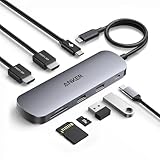
This is the one buyers choose most often across the group, and the specification sheet explains why. At 0.69 x 4.65 x 2.01 in and 3.2 oz, it disappears behind a monitor foot. Anker lists a USB-C PD input, two USB-A data ports, two HDMI outputs, Ethernet and a microSD/SD reader across eight functions, which is the widest spread here without moving to the larger Baseus body.
The video honesty is what earns it the top slot. Anker states 4K@60Hz to one display and 4K@30Hz across two, rather than making a dual-60Hz claim conditional on your laptop's DisplayPort version. You know what you are getting. Pass-through charging is quoted up to 85W, with the note that a 100W wall charger and a USB-C to C cable are needed and not supplied.
The 18-month warranty is the second-longest in the set, behind UGREEN's two-year term. Anker also says the model supports USB-C, USB4 and Thunderbolt sources, listing Windows 10 and 11 plus ChromeOS.
The trade-off against the Acer and the Nano is plain: those two claim 60Hz on both screens, and this one does not. You are buying breadth of connectivity and a small body, and paying for it in second-screen smoothness.
Pros:
- Only pick with dual HDMI, Ethernet and card reader together
- 3.2 oz and 0.69 in thick
- 18-month warranty, second-longest here
- Clear 4K@60Hz single, 4K@30Hz dual specification
- Sells faster than the rest of this set
Cons:
- Dual-display mode drops to 4K@30Hz
- 85W pass-through trails the 90W and 100W claims elsewhere
- Charger and USB-C cable not included
- Released in 2020, the oldest design in this group
2. Anker Nano Laptop Docking Station Dual Monitor — Most versatile
Every USB port on this dock is rated at 10 Gbps, and it claims dual 4K@60Hz on Windows, which no other 8-in-1 here manages.
Best for: Windows users who move large files all day Skip it if: your desk depth is genuinely tight
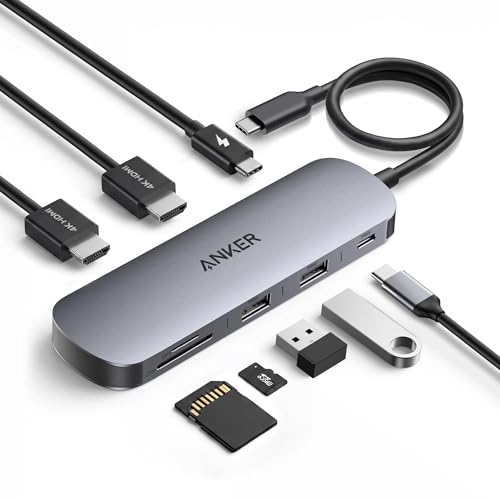
The Nano's distinguishing claim is uniform speed. Anker states 10 Gbps on the USB-C upstream plug, on the separate USB-C data port and on both USB-A ports. Most docks in this bracket mix one fast port with several slower ones, so a designer copying a folder of layered files does not have to hunt for the right socket.
It also claims 4K@60Hz on up to two external monitors, which the older 8-in-1 does not, and it is the second-cheapest pick here. Power handling is quoted at 100W PD input and 85W maximum to the laptop, with 15W reserved for the hub itself. Anker notes that the data ports carry data only, so no charging and no video from them.
The catch is physical. At 0.75 x 8.35 x 4.65 in it is the widest footprint in this comparison, over twice the length of the Anker 8-in-1 and nearly three times the UGREEN's. "Nano" describes the height, not the desk area. It weighs 3.84 oz, and the warranty field reads as 18 months.
Against the Acer, it gives up the SD slots and one USB-A port. Against the 8-in-1, it gives up Ethernet and card slots for speed and refresh rate.
Pros:
- 10 Gbps on all four USB ports
- Dual 4K@60Hz claim on Windows
- Second-cheapest pick in this comparison
- 100W input, 85W to the laptop
Cons:
- Largest desk footprint here at 8.35 x 4.65 in
- No Ethernet port
- No SD or microSD slot
- Only one seller lists it
3. Acer USB-C Docking Station Dual Monitor — Best upgrade
Nine functions including three USB-A ports, dual SD and microSD slots and a dual 4K@60Hz claim, plus a security lock button nothing else here has.

Best for: someone who wants nine ports and dual 4K@60Hz in one body Skip it if: you need published weight and size figures before buying
This is the most expensive pick here, and the specification list explains where the money goes. Acer lists two HDMI at 4K@60Hz, three USB-A at 5Gbps, one USB-C at 5Gbps, 100W PD charging and both SD and microSD slots rated up to 104Mbps. That is nine functions, the joint highest count in the set, and the only pick pairing dual 60Hz with card slots.
Two details stand out. The body has a 0.65 ft built-in cable, so nothing to lose and nothing to buy, and Acer describes a lock button: one click locks Windows, a three-second hold does the same on Mac. In a shared studio that is genuinely useful. The aluminium alloy shell should also help it shed heat under sustained dual-4K load.
Power delivery is quoted at up to 100W input and up to 90W out to the laptop, the highest laptop-side figure here.
The weakness is the data sheet itself. No published weight, no published dimensions beyond that cable length, so you cannot confirm it fits a shallow shelf before it arrives. The USB ports run at 5Gbps against the Nano's 10 Gbps, which halves the headline transfer figure. And the one-year warranty is the shortest term in this group.
Pros:
- Nine functions including three USB-A and two card slots
- Dual 4K@60Hz claim plus SD reader in one dock
- Up to 90W to the laptop, highest here
- Built-in 0.65 ft cable and aluminium body
- Lock button for shared desks
Cons:
- No published weight or dimensions
- USB ports at 5Gbps, half the Nano's rated speed
- One-year warranty, shortest in this set
- Most expensive pick here
4. UGREEN USB C Docking Station Dual Monitor — Best budget pick
The smallest body in this comparison by a wide margin, with a two-year warranty and 10Gbps on all four USB ports.

Best for: a clean two-monitor setup on the smallest possible footprint Skip it if: you need Ethernet or an SD slot
Look at the dimensions: 0.49 x 3.1 x 0.8 in, at 3.21 oz. That is under half an inch thick and barely three inches long, which makes it the only pick here you would genuinely carry in a jacket pocket without noticing. It is also the cheapest of the five.
The port set is deliberately narrow. UGREEN lists two HDMI, two USB-A at 10Gbps, two USB-C at 10Gbps and a 100W PD charging port. Seven functions, no Ethernet, no card reader. What you get instead is every data port running at the same 10Gbps rate, matching the Nano rather than the Acer's 5Gbps.
The dual 4K@60Hz claim carries a condition worth reading twice: UGREEN says your laptop must support DP 1.4. That is not exotic on recent hardware, but it is a check you need to make before ordering. The charging cable and power adapter are not included.
Two years is the longest stated warranty in this comparison, which for a small aluminium dock that lives in a bag matters more than an extra port. It also comes in black or grey, the only pick with a colour choice.
Against the Anker 8-in-1, you trade Ethernet and card slots for a much smaller body and a better refresh rate.
Pros:
- Smallest footprint here at 0.49 x 3.1 x 0.8 in
- Two-year warranty, longest in this set
- 10Gbps across all four USB ports
- Cheapest pick in this comparison
- Black or grey finish
Cons:
- No Ethernet port
- No SD or microSD slot
- Dual 4K@60Hz requires a DP 1.4 laptop
- Slowest seller apart from the Baseus
5. Baseus Laptop Docking Station Dual Monitor 9 in 1 USB C — Best premium
The only pick claiming 4K@120Hz, and the only one that spells out how differently macOS and Windows behave on dual displays.

Best for: a single-monitor desk chasing the highest refresh rate here Skip it if: you run macOS and need extended dual displays
Baseus builds this around one number: 4K@120Hz to a single display. Nothing else in this group goes past 60Hz. If your workflow involves animation previews, motion tests or simply a desire for a genuinely fluid pointer on one large panel, that is the headline.
It is a 9-in-1 with 1000Mbps Ethernet, a type-C power input for laptop charging, and both SD and TF card slots. So on paper it matches the Acer's function count and adds gigabit wired networking, which the Acer does not list.
Baseus is also the only brand here that states the platform difference outright: Windows laptops get extended dual-monitor mode with different content on each screen, while macOS devices get mirror mode only. That single line will save some readers a return.
Now the costs. At 5.3 oz and 0.63 x 5.31 x 1.93 in it is the heaviest pick here, over 60% heavier than the UGREEN. It is the second-most expensive, and it is the slowest seller of the five. The one-year warranty ties the Acer for shortest. And the 120Hz figure applies to one display, so a designer who wants two smooth screens is better served by the Acer or the Nano.
Pros:
- 4K@120Hz single-display claim, unmatched here
- 1000Mbps Ethernet plus SD and TF slots
- Nine functions in a 0.63 in thick body
- Clear statement of macOS versus Windows behaviour
Cons:
- Heaviest pick at 5.3 oz
- macOS limited to mirror mode
- One-year warranty ties for shortest
- 120Hz applies to a single display only
Does a compact docking station handle two 4K monitors?
Yes, but the answer has conditions attached, and this is where a compact docking station for graphic designers differs most from a large powered dock. Every pick here draws its video bandwidth from a single USB-C connection to your laptop.
Three variables decide whether two 4K screens actually work:
- The dock's stated dual-display mode. Anker's 8-in-1 says 4K@30Hz for two screens and does not pretend otherwise.
- Your laptop's video output. UGREEN requires DP 1.4 support for its dual 4K@60Hz mode. A machine limited to DP 1.2 will not reach it.
- Your operating system. Baseus states macOS gets mirror mode only. That is not a fault in the dock, it is how the connection behaves.
Check your laptop's specification page first. If it lists DP Alt Mode and DP 1.4, four of these five picks should give you two extended 4K screens. If it only lists DP Alt Mode with no version, plan for 30Hz on the second panel and choose the Anker 8-in-1, which is priced for that reality.
Which picks read a card straight from the dock?
Three of the five carry card slots, and if you shoot your own reference photography that narrows the field fast.
- Anker 8-in-1: microSD and SD reader, no speed figure published.
- Acer 9-in-1: SD and microSD, rated up to 104Mbps.
- Baseus 9-in-1: SD and TF slots, no speed figure published.
The Nano and the UGREEN have none, so you would be adding a separate reader and losing one of the USB ports you just bought. That defeats the purpose of a compact docking station.
Acer publishes the only transfer rate here, and 104Mbps is standard UHS-I territory rather than fast UHS-II. Fine for a card of JPEGs, slow if you regularly dump 64GB of raw files. For that volume, a dedicated reader on a 10Gbps USB port beats any of these three built-in slots. The slots are for convenience, not for bulk ingest.
What the listings do not tell you about colour work
Amazon's results for this phrase are ordinary USB-C docks, not design hardware, so treat the search modifier as a hint rather than a filter. None of these listings mentions colour depth, chroma subsampling, HDR handling or ICC profile pass-through. Not one.
That matters for colour-critical work. A dock that outputs 4K@60Hz over limited bandwidth may do it at reduced colour sampling, and no listing here states which. It is a real unknown you have to judge yourself, most reliably by connecting the dock, opening your display calibration software and checking what the monitor reports.
Three practical steps before you commit:
- Note your laptop's DisplayPort version and whether it supports DP Alt Mode.
- Decide whether your second display needs 60Hz or can live at 30Hz.
- If colour accuracy on the primary screen is non-negotiable, plan to run that monitor from a native port and use the dock for the secondary screen and peripherals.
The docks with a separate charging input, which is all five, also let you keep the laptop topped up while all this runs. Just budget for the wall charger and cable, since none of these five includes them.
The verdict
The Anker Laptop Docking Station Dual Monitor is the best compact docking station for graphic designers as a default, because it is the only pick that puts dual HDMI, Ethernet and a card reader in a 3.2 oz body, and because Anker states its dual-display limit plainly at 4K@30Hz instead of burying a DisplayPort condition. An 18-month warranty and the fastest sales pace here back that up.
Two conditions flip it. First, if both monitors do real work and you want 60Hz on each, the Acer 9-in-1 is the answer: nine functions, dual 4K@60Hz, card slots, a built-in 0.65 ft cable and up to 90W to the laptop, at the highest price position in this set. Second, if you move large files constantly, the Anker Nano's uniform 10 Gbps across all four USB ports beats the Acer's 5Gbps outright, provided you can spare 8.35 in of desk length.
The runner-up advantage is precise. Acer gives you 60Hz on the second display and an SD reader in one device, which is a combination nothing else here offers. What it costs you is a published weight and dimensions, so you buy without knowing whether it fits your shelf.
FAQ
Is a compact docking station worth it over a full-size dock?
A compact docking station is worth it when desk space and portability matter more than port count. All five picks here fit under 1 in thick, and four publish weights between 3.21 oz and 5.3 oz. You give up the extra display outputs and dedicated power supply a full-size dock offers. If your laptop never leaves the desk, a larger dock makes more sense.
Which is the better value pick in this comparison?
The better value pick is the UGREEN 7-in-1. It is the cheapest of the five, carries the longest stated warranty at two years, runs 10Gbps on all four USB ports and measures just 0.49 x 3.1 x 0.8 in. You lose Ethernet and card slots. If neither is part of your workflow, nothing else here gives you more per unit of cost.
Anker 8-in-1 or Acer 9-in-1: which should I buy?
Anker 8-in-1 or Acer 9-in-1 comes down to your second monitor. Choose the Anker if 4K@30Hz on the secondary screen is acceptable and you want Ethernet plus a card reader in a 3.2 oz body with an 18-month warranty. Choose the Acer if you need 4K@60Hz on both screens, three USB-A ports and SD slots, and you accept a one-year warranty.
Do these docks work with a MacBook and two monitors?
These docks work with a MacBook, but dual-display behaviour varies. Baseus states plainly that macOS devices get mirror mode only, showing the same content on both screens, while Windows laptops get extended mode. Anker lists Windows 10, Windows 11 and ChromeOS compatibility and notes support for USB-C, USB4 and Thunderbolt sources. Check your specific Mac's external display limit before ordering.
What mistake do buyers make with these docks?
The mistake buyers make is assuming a charger is included. UGREEN states the charging cable and power adapter are not supplied, and Anker notes its 85W pass-through needs a 100W PD wall charger and a USB-C to C cable you provide separately. Ordering the dock alone and expecting your laptop to charge through it leads straight to a second order.
Start with your laptop's specification page, not the dock's. Find the DisplayPort version behind its USB-C port, then decide whether your second screen can live at 30Hz. That single answer picks your dock in about a minute. If the answer is yes, the Anker 8-in-1 gives you the widest port mix in this set at 3.2 oz, with Ethernet and a card reader that the cheaper UGREEN leaves out, and 18 months of warranty behind it. If the answer is no, spend up on the Acer and take the dual 4K@60Hz. Either way, order a 100W charger at the same time.