Best Ergonomic Docking Station by Ports and Displays

One dock lifts your monitor and hides the peripherals underneath. Another drives three 4K screens. Here is which best ergonomic docking station for programmers actually fits your desk.

By Aidyn MeadowsUpdated 16 min read
On this page
- Best ergonomic docking station for programmers at a glance
- How I screened the docking stations for this shortlist
- Why a docking station is an ergonomic tool, not just a hub
- 1. Anker 675 USB-C Docking Station — Best overall
- 2. Anker Prime Docking Station — Best premium
- 3. Plugable USB C Triple Display Docking Station — Best for pros
- 4. Acer 13-in-1 Laptop Docking Station — Best minimal setup
- 5. Plugable Universal Laptop Docking Station Dual HDMI — Best upgrade
- 6. JINPIAOPIAO Foldable Aluminum 7 Port Docking Station — Best budget pick
- How many displays does a programmer actually need?
- Ports that matter for a coding setup
- What the listings do not tell you about drivers
- Is the modifier for programmers doing any work here?
- The verdict
- FAQ
The best ergonomic docking station for programmers is the Anker 675, because it doubles as a monitor stand: your screen sits on top, your keyboard and mouse tuck underneath, and a single 100W USB-C cable feeds the laptop. If you need three external displays instead of one lifted one, the Anker Prime DL7400 drives triple 4K over a 140W upstream port and wins on raw pixels. Both cost more than the rest of this set, and both earn it in different ways.
Best ergonomic docking station for programmers at a glance
| Pick | Displays | Laptop power | Price |
|---|---|---|---|
Best overall Anker 675 USB-C Docking Station |
1x 4K HDMI | 100W USB-C | Check Price |
Best premium Anker Prime Docking Station |
Triple 4K (2x HDMI + 1x DP) | 140W USB-C | Check Price |
Best for pros Plugable USB C Triple Display Docking Station |
3x HDMI (1x 4K 30Hz, 2x 1080p 60Hz) | 100W PD | Check Price |
Best minimal setup Acer 13-in-1 Laptop Docking Station |
2x HDMI + 1x DP 1.4 | 100W via 110W adapter | Check Price |
| 2x HDMI, 1920x1200 @ 60Hz | Not included | Check Price | |
Best budget pick JINPIAOPIAO Foldable Aluminum 7 Port Docking Station |
1x Type-C 4K 30Hz claim | No adapter | Check Price |


How I screened the docking stations for this shortlist
I started with the Docking Stations node of Amazon's Laptop Accessories category and lined up the listings by the specifications a coder actually uses: how many external displays the dock drives, how many watts it feeds back to the laptop, and whether the physical shape changes your posture. Everything else is secondary.
Three cuts thinned the field:
- No laptop power on the upstream port dropped anything that expects you to plug the charger in separately, unless the dock earned its place another way.
- Fewer than four downstream ports dropped the pocket hubs. A programmer plugs in a keyboard, a mouse, headphones or a mic, often an external drive, and often an Ethernet cable.
- No published display resolution dropped the listings that only advertise "HD" without saying which flavour.
Six survived, and they split cleanly by shape. Two are slab-style docks that sit next to the laptop. Three are flat pucks the same shape as a chocolate bar. One, the Anker 675, is a monitor riser with a dock built into the base. That last shape is the one that changes how you sit.
Why a docking station is an ergonomic tool, not just a hub
A dock is ergonomic when it fixes one of three things: your neck angle, your wrist angle, or the cable spaghetti that forces you to twist to reach a port. Most docks on Amazon fix only the third. The Anker 675 fixes all three at once, which is why it leads this set.
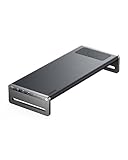
Neck angle is the big one for programmers. Read a screen for eight hours at desk height and you tilt your chin down. Lift the monitor about 3 to 4 inches and the top of the panel lands roughly at eye level, which is where the neck wants it. The Anker 675 is 3.54 in tall, so it does that job in a single object. A flat puck dock leaves the monitor at desk height and asks you to buy a separate riser.
Wrist angle follows from where the keyboard sits. A monitor stand with a shelf underneath, like the 675, lets you slide the keyboard back when you stop typing, so the desk edge stops pressing into your forearms. The flat docks in this set do not touch that problem.
1. Anker 675 USB-C Docking Station — Best overall
A dock, a monitor stand, and a keyboard garage in one 3.65 lb piece of hardware.
Best for: a single-monitor coder who wants the screen lifted and the desk cleared Skip it if: you need three external displays
The 675 is the only pick in this set that changes your posture rather than your cable count. Its footprint is 21.3 in wide and 8.66 in deep, which is enough room for most 24 to 27 in monitors to sit on top, and 3.54 in of height puts the panel where your neck wants it. Anker says the dock is a 12-in-1 with a 100W USB-C upstream port, three USB-A, two USB-C sharing 45W, SD and microSD slots, 4K HDMI out and a wireless charging pad on the top surface for a phone. The wireless pad is genuinely useful for a programmer: your phone sits above the desk where notifications are visible, not face-down next to the keyboard. Warranty is 18 months.
The trade-off is scope. One HDMI output means one external monitor, and if your workflow demands two panels the 675 cannot deliver them.
Pros:
- Lifts the monitor 3.54 in without a separate riser
- 100W upstream powers most 14 to 16 in laptops
- Wireless charging pad on the top surface
- 21.3 in wide fits most 24 to 27 in monitors
- Hides the keyboard under the shelf when you stop typing
Cons:
- Only one HDMI output, so no multi-monitor setup
- The most expensive pick here after the Prime
- 18 months of warranty, shorter than the Plugable pair
- Bigger footprint than a slab dock, so no good for travel
2. Anker Prime Docking Station — Best premium
The port count and power budget of a proper workstation dock in a 1.84 lb slab.

Best for: a developer running three 4K panels with a 140W laptop Skip it if: you are on macOS and want native triple 4K without DisplayLink
The Prime is the raw-capacity pick. Anker lists 14 connections including a 140W 10Gbps USB-C upstream, two 100W 10Gbps USB-C ports, one 100W 5Gbps USB-C port, two HDMI, one DisplayPort and support for three 4K displays at once. That 140W upstream is the number to notice: it is the only dock in this set that can fully feed a 16 in workstation laptop under load without dropping to trickle charge. Anker calls out Windows 10 and 11 compatibility for the triple-display mode, which uses DisplayLink. There is a small smart display on the front that shows charging power and cooling status, which is a gimmick until the day your laptop is not charging and you want to know why.
Dimensions are 1.89 x 7.67 x 3.62 in and weight is 1.84 lb, so it sits under a monitor arm without complaint. Warranty is 18 months, the same as the 675.
Pros:
- 140W upstream is the highest in this set
- Triple 4K display support via DisplayLink
- Every USB-C port supports both charging and data
- Front smart display reports charging and cooling state
- 10Gbps on the top-tier USB-C ports
Cons:
- The most expensive pick in this set
- Triple-display mode is Windows-only per Anker
- 18 months of warranty, shorter than Plugable's 2 years
- No monitor-riser shape, so your neck is still on you
3. Plugable USB C Triple Display Docking Station — Best for pros
Triple output that works across Windows, macOS and ChromeOS with a two-year warranty.

Best for: a cross-platform coder who needs triple output on macOS or ChromeOS Skip it if: you refuse to install DisplayLink drivers
This is the pick for the developer whose team uses a mix of MacBooks, Windows laptops and Chromebooks and wants one dock the whole bench can share. Plugable states 3x HDMI with one 4K 30Hz via Alt Mode and two 1080p 60Hz via DisplayLink, six 5Gbps USB ports, and 100W PD upstream. The listing says it works with USB-C, USB4 and Thunderbolt laptops on Windows, macOS 11+ with a driver, and ChromeOS. Dimensions are 1.18 x 7.87 x 3.54 in and weight is 0.73 lb, the lightest of the six.
The important number is 30Hz on the 4K output. For code, a browser and a terminal that is fine. For scrolling long files or moving windows around fast it feels sticky. Plugable also promises a 2 year limited parts and labour warranty plus lifetime support, which is longer than either Anker.
Pros:
- Works on Windows, macOS and ChromeOS per Plugable
- 2 year warranty and lifetime support
- 0.73 lb, the lightest pick in this set
- 100W PD upstream is enough for most ultrabooks
- Six 5Gbps USB ports for peripherals
Cons:
- 4K output is capped at 30Hz per the listing
- DisplayLink drivers are required for the second and third screens
- No DisplayPort output, only HDMI
- No monitor-riser shape
4. Acer 13-in-1 Laptop Docking Station — Best minimal setup
A slim Windows-focused dock that ships with the 110W adapter in the box.

Best for: a Windows developer who wants triple display in a slim slab Skip it if: you work on a Mac
At 0.94 x 7.89 x 3.25 in the Acer is the flattest dock here, and it is the only one that includes a 110W power adapter in the box, so you are not hunting for a spare charger the day it arrives. Acer says the upstream port delivers 100W to the laptop under that adapter. The display side is 2 HDMI plus one DisplayPort 1.4 for triple independent screens on Windows laptops using MST. The port count Acer calls out is 3 USB-A for data, one USB-C for data and one USB-C for the host connection, plus networking, storage, audio and the display outputs.
Two catches. First, the triple-display feature is described for Windows laptops, so Mac users should look at Plugable. Second, warranty is 1 year, the shortest of the mid and premium picks.
Pros:
- 110W power adapter included in the box
- Triple display via MST on Windows laptops
- Very slim slab at 0.94 in tall
- DisplayPort 1.4 output alongside two HDMI
- 100W to the laptop via USB-C PD
Cons:
- Triple display described for Windows, not Mac
- 1 year warranty is the shortest here
- No published weight in the listing
- Not a riser shape, so no posture help
5. Plugable Universal Laptop Docking Station Dual HDMI — Best upgrade
The dock for a five-year-old ThinkPad that still needs a second screen and Ethernet.

Best for: a Windows coder still on an older laptop with a spare USB 3.0 port Skip it if: you edit video, game, or watch DRM streams on the dock
The UD-3900 is the odd one out and the useful one out. It carries a hybrid 2-in-1 USB 3.0 and USB-C cable, so it works with laptops that never had a USB-C port to begin with. Plugable states two HDMI outputs up to 1920x1200 at 60Hz, or a single HDMI up to 2560x1440 at 50Hz, plus Gigabit Ethernet, audio and six USB ports. Weight is 0.81 lb, dimensions are 4.02 x 6.45 x 3.22 in, and Plugable covers it with a 2 year limited parts and labour warranty. The listing is explicit that 4K is not supported and that DisplayPort connections, gaming and HDCP-protected streams like Netflix are out of scope.
For code, none of those omissions matter. For a coder on an older Windows laptop who wants two 1080p editors side by side plus wired network, this is the dock buyers choose most often in this set.
Pros:
- Works with older USB 3.0 laptops as well as USB-C
- 2 year warranty and Seattle-based email support
- 2 HDMI outputs at 1920x1200 60Hz per Plugable
- Gigabit Ethernet and six USB ports
- Sells faster than the rest of this set
Cons:
- No 4K support at all per the listing
- Does not carry laptop power, so you still need the charger
- No HDCP, so streaming services will not play through it
- Requires DisplayLink driver installation
6. JINPIAOPIAO Foldable Aluminum 7 Port Docking Station — Best budget pick
A folding aluminium laptop stand with seven ports baked into the frame.

Best for: a traveller who wants a folding stand and a few ports in one aluminium slab Skip it if: you need charging pass-through or a warranty on paper
The JINPIAOPIAO is the cheapest of the six and the most travel-friendly by shape. It is a 266x60x25mm aluminium plate that folds up, unfolds into a laptop stand with cooling vents cut into the metal, and carries seven ports along one edge. The listing claims USB 3.0 and a Type-C port with 4K at 30Hz. The listing itself calls out programmers and video editors as target users, which is the only place in this dataset where the word programmer appears.
The trade-off is transparency. This is the only pick in the set with no published weight, no published warranty and the slowest sales position of the six. Treat the 4K claim as the manufacturer's, and expect no charger to feed the laptop back through the dock. As an ergonomic tool it does one useful job well: lifting the laptop off the desk when you use its built-in screen.
Pros:
- The cheapest pick in this set
- Folds flat for travel
- Aluminium body with cooling vents for the laptop base
- 7 ports in one edge
- Doubles as a laptop stand
Cons:
- No published weight or warranty
- The slowest seller of the six
- No laptop power pass-through mentioned
- 4K at 30Hz is a manufacturer claim, not a standardised figure
- Only one seller lists it
How many displays does a programmer actually need?
The dock market pushes triple 4K hard, and for most coding work that is more pixels than the job requires. Look at what a programmer actually keeps open: an editor, a terminal, a browser with docs, sometimes a chat window, sometimes a database client. Two screens covers that. Three helps if one of them is a permanent dashboard: Grafana, a CI pipeline, or a stand-up video call that runs all morning.
The picks in this set map to that decision cleanly:
- One external display: Anker 675. The advantage is the lift, not the count.
- Two external displays at 1080p or 1200p: Plugable UD-3900. Cheapest way to get there on an older laptop.
- Three external displays, Windows only: Anker Prime for 4K on all three, Acer 13-in-1 for a slim slab.
- Three external displays, any OS: Plugable UD-3900PDZ, accepting 30Hz on the 4K channel.
If you cannot decide between two and three screens, buy for two. A third monitor eats desk depth and forces your head to swing further left or right than the neck likes.
Ports that matter for a coding setup
Every dock in this set has enough USB ports. What splits them is which other jacks are on the back panel, and the answer is not the same for every coder.
- Ethernet. A wired gigabit port is worth more than a fast USB port if you push large repos, pull container images, or join video calls from a flaky Wi-Fi corner. Plugable and Acer are explicit about Gigabit Ethernet.
- SD and microSD. Only the Anker 675 calls out card slots. Useful if you flash Raspberry Pi images or shuffle firmware.
- DisplayPort. The Anker Prime and the Acer 13-in-1 give you a proper DisplayPort output, which matters if your main monitor is a high-refresh panel with a DP input and no HDMI 2.1.
- Upstream wattage. 100W is the floor for a modern ultrabook. 140W, which only the Prime offers, is the number for a 16 in workstation laptop compiling under load.
A quick way to decide: list the four peripherals on your desk right now, then the two you plan to add. Count ports, add two, and buy a dock with that number.
What the listings do not tell you about drivers
Three of these docks depend on DisplayLink for their second or third display, and the listings mention it in passing. In practice, the first thing a new dock asks for on a Mac or ChromeOS box is a driver install and a reboot. That is not a defect, but it is a step buyers miss.
The Anker 675 uses HDMI Alt Mode over USB-C for its single monitor output, so no driver is needed on a modern laptop. The Anker Prime and both Plugable docks use DisplayLink for extra monitors, and the Prime's triple-display mode is called out for Windows 10 and 11. On macOS the driver install is straightforward, but Apple's system extension prompts will interrupt you the first time.
Two useful habits: install the DisplayLink driver before you plug the dock in, and reboot after. And keep the dock's model number written down somewhere, because DisplayLink release notes are the first place to check when a monitor refuses to wake up.
Is the modifier for programmers doing any work here?
Amazon's search treated "for programmers" as a soft filter here rather than a hard one, and only one listing in the set, the JINPIAOPIAO, actually names programmers in its copy. That does not mean the modifier is meaningless. It means you have to judge fit yourself from the specifications, because none of these docks is engineered specifically for code work.
What programmer-friendly actually looks like in a dock:
- Enough upstream power to charge the laptop while it compiles.
- Enough displays to keep an editor, a browser and a terminal visible at once.
- A wired Ethernet port that survives a video call.
- A physical shape that does not force you to hunch to read the monitor.
Score each pick against those four and the ranking above holds. The Anker 675 wins on shape and power. The Anker Prime wins on displays and power. The Plugable pair win on cross-platform support and warranty. The Acer wins on the "everything in the box" test. The JINPIAOPIAO wins on price and travel, and on nothing else.
The verdict
The Anker 675 is the best ergonomic docking station for programmers because it is the only pick in the set that changes how you sit. Its 3.54 in of height lifts your monitor to eye level, its 21.3 in shelf hides the keyboard when you stop typing, and its 100W upstream feeds most laptops through a single USB-C cable. That is three ergonomic problems solved in one object, and no other dock in this set solves more than one of them.
Two conditions flip the pick. If you need three external displays, the Anker Prime DL7400 is the correct choice: 140W upstream, triple 4K over DisplayLink on Windows, and 10Gbps on the top USB-C ports. If your team uses a mix of Windows, macOS and ChromeOS laptops, the Plugable UD-3900PDZ is the safer buy, because it publishes cross-platform support and a 2 year warranty, at the cost of a 30Hz cap on its 4K output.
The runner-up's exact advantage over the winner is pixel count. The 675 gives you one lifted monitor. The Prime gives you three flat ones. Programmers who live inside a single editor should take the lift. Programmers who live across dashboards should take the pixels.
FAQ
Is an ergonomic docking station worth it for a programmer working from home?
Is an ergonomic docking station worth it for someone who codes eight hours a day at a home desk? Yes, if the dock does more than add ports. A dock that lifts the monitor to eye level, like the Anker 675 at 3.54 in, fixes neck angle in the same object that carries the cables. A flat puck dock only tidies the wires. For a full-time home coder, the riser shape is worth the price gap.
How many monitors can the Anker Prime DL7400 drive at once?
How many monitors can the Anker Prime handle in a coding setup? Anker states triple 4K display support on Windows 10 and 11, using two HDMI ports and one DisplayPort, powered by a 140W USB-C upstream and DisplayLink for the extra outputs. Every USB-C port on the dock handles both power and data, and the top-tier ports run at 10Gbps. Mac users should look elsewhere for native triple 4K.
Does the Anker 675 work as a monitor stand on its own?
Does the Anker 675 work as a monitor stand for a typical 27 in panel? Yes. Its footprint is 21.3 in wide by 8.66 in deep, which fits most 24 to 27 in monitor bases, and its 3.54 in height lifts the top of the screen close to eye level for most users. The shelf underneath is deep enough to slide a full-size keyboard and a mouse out of the way when you are not typing.
Plugable UD-3900 vs UD-3900PDZ, which is right for a coder?
Plugable UD-3900 vs UD-3900PDZ comes down to laptop age and display needs. The older UD-3900 uses a hybrid USB 3.0 and USB-C cable, drives two HDMI screens up to 1920x1200 at 60Hz, and does not pass laptop power. The newer UD-3900PDZ carries 100W PD, drives three HDMI outputs with one at 4K 30Hz, and supports Windows, macOS and ChromeOS.
What is the biggest mistake buyers make choosing a docking station?
The biggest mistake buyers make is buying for port count instead of upstream wattage. A dock with 20 ports and 60W of upstream power will run your keyboard fine and starve your 16 in laptop during a build. Check the USB-C upstream number first: 100W for an ultrabook, 140W for a workstation like the Anker Prime. Everything else, including the fourth USB-A port, matters less than that.
The next step is a small one. Measure the height of your current monitor from the desk to the top edge, and compare it to the height of your eyes when you sit up straight. If the top of the screen is more than an inch below your eye line, the Anker 675 is the right default here: it lifts the panel and clears the desk in one purchase, without you having to buy a separate riser. If your monitor already sits at the right height, spend the money on displays and power instead, and let the Anker Prime carry three panels off a single 140W cable.