Best Rain Barrel for Garden: RTS ECO 50 Leads

Six rain barrels and spigot kits compared on capacity, footprint and outlet hardware, with a named winner and the exact conditions that flip the pick to something else.

By Aidyn MeadowsUpdated 17 min read
On this page
- Best rain barrel for garden at a glance
- Three reasons picks got cut
- What actually decides a rain barrel purchase?
- 1. RTS Home Accents 50-Gallon ECO Rain Barrel — Best overall
- 2. Step2 Lakewood Rain Barrel with Stand — Best premium
- 3. RTS Home Accents 50-Gallon Rain Barrel with Brass Spigot — Best minimal setup
- 4. Pure Garden 13.2-Gallon Collapsible Rain Barrel — Best upgrade
- 5. BILAL Brass Rain Barrel Spigot — Best for pros
- 6. VYH PVC Rain Barrel Spigot Kit — Best budget pick
- Will it fit beside a garden bed?
- Spigot hardware: brass, PVC or the one it ships with?
- What owning a rain barrel actually involves
- The verdict
- FAQ
The best rain barrel for garden use is the RTS Home Accents 50-Gallon ECO, because its flat back and 34 x 24 x 19 in footprint let it sit hard against a wall where a round barrel can't. If you'd rather fill a watering can standing up, the Step2 Lakewood holds 60 gallons on a built-in stand at 46 in tall. The specification that splits this field isn't capacity. It's outlet height and the hardware bolted through the barrel wall.
Best rain barrel for garden at a glance
| Pick | Capacity | Footprint / size | Price |
|---|---|---|---|
Best overall RTS Home Accents 50-Gallon ECO Rain Barrel |
50 gal claim | 34 x 24 x 19 in 18 lb |
Check Price |
Best premium Step2 Lakewood Rain Barrel with Stand |
60 gal claim | 46 x 20 x 24 in 34 lb |
Check Price |
Best minimal setup RTS Home Accents 50-Gallon with Brass Spigot |
50 gal claim | 19 x 34 x 21 in 18 lb |
Check Price |
Best upgrade Pure Garden Collapsible Rain Barrel |
13.2 gal / 50 L | 21 x 15.7 x 15.7 in 2.2 lb |
Check Price |
Best for pros BILAL Brass Rain Barrel Spigot |
Spigot only | 0.75 x 3 x 2 in 0.55 in outlet |
Check Price |
Best budget pick VYH PVC Rain Barrel Spigot Kit, 2 Pack |
Valve kit, 2 pack | 3/4 in GHT | Check Price |


Three reasons picks got cut
I started from the Rain Barrels & Accessories listings and cut before I compared. Three disqualifications did most of the work.
- No published dimensions. A barrel that doesn't state its footprint is a barrel you can't plan around. If the listing won't say how wide it is, it can't make a shortlist aimed at beds and side yards.
- No stated outlet. Several candidates describe capacity and colour and go silent on the spigot. That's the part that fails first and the part that decides whether a hose will run.
- Capacity with no plan for overflow. A barrel with no overflow port or linking claim turns into a puddle against your foundation the first time a storm outruns it.
What survived is six listings that publish enough to compare: four with hard dimensions, and two hardware picks that exist because the outlet is the weak point in this category. Two of the six are spigot and valve kits rather than barrels, which is deliberate. If you already own a drum, or you're replacing a cracked plastic tap, the useful purchase is hardware.
Note one thing about the set. Only the two RTS barrels publish a warranty, both at one year. Everything else in this group ships with nothing stated on that front.
What actually decides a rain barrel purchase?
Most guides to the best rain barrel for garden watering rank by gallons. Gallons is the specification that misleads. Here's why.
A 50-gallon barrel fills in a single moderate storm off a modest roof section. Once it's full, extra capacity does nothing, because the overflow dumps the rest anyway. So the jump from 50 to 60 gallons changes far less than the numbers suggest.
What changes everything is outlet height. Water leaves a rain barrel under gravity alone, so the vertical distance between the spigot and the thing you're filling is your entire water pressure. Set a barrel on the ground and the tap sits a few inches up. Fill a watering can under it and you'll be tipping the can sideways on the grass. That's the failure mode that turns a barrel into a lawn ornament by July.
Three things follow from that:
- A barrel with a built-in stand, like the Step2 Lakewood at 46 in tall, gives you usable height without building anything.
- A ground-level barrel needs a platform. Cinder blocks, a pallet, a stack of pavers. Budget for it before you buy.
- A hose run needs more head than a watering can. Drip line off a barrel is realistic; a sprinkler is not.
The second deciding factor is the spigot material. Both RTS barrels carry the same 50-gallon claim and near-identical dimensions, and the real difference between them is that one lists a plastic spigot and the other lists brass.
1. RTS Home Accents 50-Gallon ECO Rain Barrel — Best overall
The flat back and 24 in width make this the easiest 50-gallon barrel here to tuck against a wall, and it's the one buyers choose most often in this group.
Best for: a downspout tight against the house wall Skip it if: you need a hose to run under gravity pressure
At 34 x 24 x 19 in this is a tall, shallow barrel rather than a drum. That 19 in depth is the number that matters when your downspout runs down a wall with a planting bed in front of it. RTS describes the back as flat, which is what allows the barrel to sit flush instead of leaving a wedge of dead space behind it.
It's also the lightest of the three rigid barrels at 18 lb, so one person can position it empty. RTS says the shell is UV-resistant polyethylene made from 100% recycled plastic, and that a built-in overflow valve lets you link a second barrel. The listed spigot is plastic.
That spigot is the compromise. It's the part most likely to weep at the bulkhead after a couple of freeze cycles, and it's why the two hardware picks below exist. RTS publishes a one-year warranty here, which only one other pick in this set does. Against the Step2, you give up the built-in stand and 10 gallons; against its own walnut sibling, you give up brass. What you get back is the smallest wall footprint on this list and the mid price position rather than the top.
Pros:
- Flat back sits flush against a wall
- Only 19 in deep, the shallowest rigid barrel here
- 18 lb empty, easy to place solo
- Built-in overflow valve for linking a second barrel
- One-year warranty, rare in this set
Cons:
- Plastic spigot rather than brass
- No stand, so you supply the platform
- Ground-level outlet gives very little hose pressure
- Only one seller lists it
2. Step2 Lakewood Rain Barrel with Stand — Best premium
The only pick here that solves outlet height out of the box, standing 46 in tall with a brass spigot included.

Best for: filling watering cans without stooping Skip it if: your downspout sits under a low soffit
This is the most expensive pick here and the reasoning is straightforward: you're buying height and hardware together. Assembled dimensions are 46 x 20 x 24 in, and Step2 says the raised design improves pressure and makes filling a watering can easier. That's the one problem no other barrel on this list fixes for you.
The hardware is a step up too. Step2 lists a stainless steel mesh screen filter to catch fine grit, and a 3/4 in brass spigot in the box. The shell is described as double-walled plastic in colours that won't chip, fade, crack or peel, and Step2 claims multiple barrels can be linked for overflow. It holds 60 gallons by the listing's claim, the largest here.
At 34 lb it's nearly twice the weight of either RTS barrel empty, so plan the position once. It's also the tallest thing here by 12 in, which becomes a real constraint if your downspout elbow sits low. This is a 2025 release with no warranty stated, and it's the slowest seller of the six, so it has less track record behind it than the RTS barrels. The trade-off against the winner is footprint: 24 in wide and not flat-backed.
Pros:
- 46 in height solves gravity pressure without a platform
- 3/4 in brass spigot included, not plastic
- Stainless steel mesh screen filter
- 60 gallon claim, largest capacity here
- Double-walled construction
Cons:
- Most expensive pick in this group
- 34 lb empty, heaviest here
- 46 in tall may not clear a low downspout elbow
- No warranty stated
3. RTS Home Accents 50-Gallon Rain Barrel with Brass Spigot — Best minimal setup
Same flat-back 50-gallon body as the winner, but with a brass spigot fitted, so there's nothing to upgrade later.

Best for: a brass spigot straight out of the box Skip it if: recycled content matters to you
Set this beside the ECO version and the shapes are almost identical: 19 x 34 x 21 in against 34 x 24 x 19 in, both 18 lb, both flat-backed, both carrying a one-year parts warranty. RTS lists the same UV-resistant polyethylene shell and the same built-in overflow valve for linking barrels.
The difference is the tap. RTS specifies a brass spigot here and calls it leak-free, where the ECO lists plastic. Brass is the part of a rain barrel that survives a winter you forgot to drain. If you'd rather not drill out a plastic fitting in year two, buying the brass version up front is the shorter path, and it's why this earns the minimal-setup label.
The walnut colour is the other split. It reads more like a planter than a utility drum, which matters if the barrel sits somewhere you look at.
Two costs, though. This one sits in the higher price positions here despite matching the ECO's capacity, so you're paying for the tap and the finish rather than any extra volume. And the recycled-plastic claim RTS makes on the ECO isn't repeated on this listing. It also sells more slowly than the ECO. Like the winner, it arrives with no stand, so the platform is still your job.
Pros:
- Brass spigot fitted from new
- Flat back, 19 in deep
- 18 lb empty, same as the ECO
- One-year parts warranty
- Walnut finish suits visible spots
Cons:
- Higher price position than the ECO for the same capacity
- No recycled-content claim on this listing
- No stand included
- Only one seller lists it
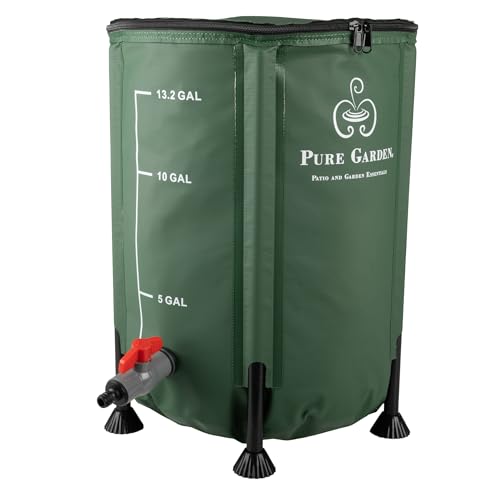
4. Pure Garden 13.2-Gallon Collapsible Rain Barrel — Best upgrade
At 2.2 lb and collapsible, this is the only pick you can fold flat and carry indoors for winter.
Best for: renters and off-season storage Skip it if: you water a large plot
This is the odd one out, and it earns its place on portability. It holds 13.2 gallons or 50 litres, roughly a quarter of what the RTS barrels claim, and it weighs 2.2 lb empty. Every rigid barrel here weighs at least eight times that.
Pure Garden lists a PVC frame and cover described as anti-UV and tear-resistant, a 3 in mesh intake filter on top, and an outflow valve. Setup is as simple as it gets: put it under a downspout and let the water run through the mesh. Standing dimensions are 21 x 15.7 x 15.7 in, so it occupies less than half the width of the winner.
Call it an upgrade over a bucket rather than a step up from a 50-gallon drum. That's the honest framing. 13.2 gallons is a few watering cans for containers, a raised bed, or a greenhouse bench. It's not a lawn.
The other limits follow from the material. There's no linking or overflow claim, no warranty stated, and a fabric-and-frame container will not take the abuse a polyethylene shell shrugs off. At 21 in tall it also sits lowest of anything here, so the outlet height problem is at its worst. Set it on a bench.
Pros:
- 2.2 lb empty, lightest here by far
- Folds flat for shed or garage storage
- 3 in mesh intake filter included
- 15.7 in square footprint, narrowest of the barrels
- Outflow valve fitted
Cons:
- 13.2 gallons, a quarter of the RTS capacity
- No overflow or barrel-linking claim
- PVC and frame less durable than moulded plastic
- 21 in tall, lowest outlet in the set
5. BILAL Brass Rain Barrel Spigot — Best for pros
Solid brass ball valve with a 0.55 in outlet, for anyone replacing the plastic tap a barrel shipped with.

Best for: upgrading a leaking plastic outlet Skip it if: you don't own a drill
This is hardware, not storage, and it's here because the spigot is where rain barrels fail. BILAL lists solid brass construction, a quarter-turn ball valve, a 3/4 in male GHT threaded outlet that takes a standard garden hose, and thread seal tape in the box. Overall size is 0.75 x 3 x 2 in.
The number worth noting is the bore. BILAL states a 0.55 in water outlet against a typical 0.39 in, and claims roughly double the flow as a result. On a gravity-fed barrel where you have almost no pressure to spare, a wider outlet is one of the few ways to speed a fill. The larger alloy handle is also a genuine detail on a tap you'll turn with wet hands.
Fit this to either RTS barrel or to a repurposed food-grade drum and you've solved the weakest link for a small outlay. It sits in the entry price positions here.
The catch is installation. BILAL says the job needs a drill and a 1-1/4 in saw bit or a 1 in adjustable wrench, so this is not a drop-in swap for the nervous. It's a single unit with no dimensions given for the gasket, no warranty stated, and it does nothing on its own. You still need a barrel.
Pros:
- Solid brass, corrosion-resistant
- 0.55 in outlet, wider than typical
- 3/4 in male GHT fits standard hoses
- Quarter-turn ball valve with large handle
- Thread seal tape supplied
Cons:
- Requires a drill and a 1-1/4 in saw bit
- Single spigot, not a pair
- No warranty stated
- Not a barrel, so it's an add-on cost
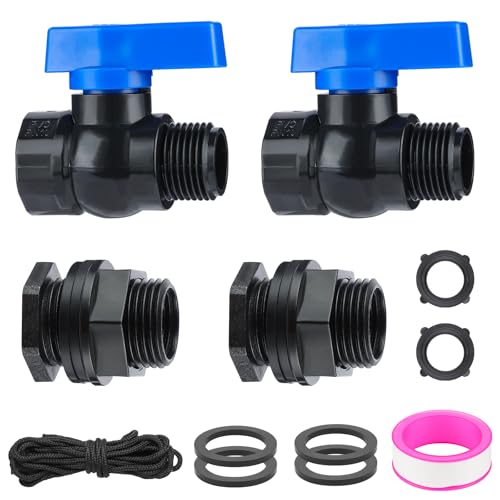
6. VYH PVC Rain Barrel Spigot Kit — Best budget pick
Two 3/4 in GHT ball valves with bulkhead fittings in one box, the cheapest way here to plumb a barrel or link two.
Best for: plumbing two barrels together Skip it if: you want metal hardware
The count is the point. VYH lists two 3/4 in GHT PVC ball valves, two plastic adapters, thread seal tape and a traction rope in one kit, which makes it the only multi-piece hardware pick here and the cheapest thing in this group.
Two valves is exactly what a linked pair of barrels needs: one draw tap on each, or a draw tap plus a transfer point. Both RTS barrels claim you can connect a second barrel, so if you're building a two-barrel run this is the matching hardware. VYH describes 3/4 in GHT male threads and a thick rubber gasket for a watertight hose connection, and says the same fittings suit tanks, ponds and aquariums.
Where it loses to the BILAL is material. PVC against solid brass is the whole comparison. VYH calls the structure sturdy and suitable for year-round use, but a plastic valve body is the component people end up replacing, which is the reason a brass spigot is worth paying for on a barrel you'll keep.
The listing is also the thinnest here on specifications. Beyond the 3/4 in size and a black and blue colour note, there's no weight, no bore diameter and no warranty. It publishes less than any other pick in this set.
Pros:
- Two valves and two adapters per kit
- 3/4 in GHT threads accept garden hoses
- Rubber gasket bulkhead sealing
- Cheapest pick in this group
- Thread seal tape included
Cons:
- PVC valve bodies, not brass
- No bore diameter published
- Fewest published specifications of any pick here
- Needs a drilled hole and a barrel to be useful
Will it fit beside a garden bed?
This is where the flat back earns its keep, and it's the question most shoppers skip. Measure two things before you buy: the clear width beside your downspout, and the height of the elbow.
- Narrowest depth: the RTS ECO at 19 in, with its flat back designed to sit flush to the wall.
- Narrowest overall: the Pure Garden at 15.7 x 15.7 in, if 13.2 gallons is enough.
- Widest: the Step2 at 24 in wide, in exchange for its 46 in height.
- Tallest: the Step2 again, at 46 in. That's the one to check against a low soffit or a window sill.
A flat-backed barrel matters more than the raw numbers suggest. A round drum of the same volume leaves a curved gap behind it that fills with leaves and stays wet against your siding. The RTS pair avoid that.
One more measurement. If you plan to raise a ground-level barrel on blocks, add the platform height to the barrel height and check that total against the downspout cut. Two courses of cinder block is roughly 16 in, which puts a 34 in RTS barrel at around 50 in overall. That's taller than the Step2 already stands.
Spigot hardware: brass, PVC or the one it ships with?
Three of these six picks bear directly on the outlet, so it's worth being clear about the choice.
Brass wins on longevity. It resists corrosion, it doesn't go brittle in UV, and it survives the freeze that splits a plastic tap. The Step2 includes a 3/4 in brass spigot, the walnut RTS includes brass, and the BILAL is solid brass with a 0.55 in bore.
PVC wins on cost and count. The VYH kit gives you two valves with bulkhead fittings and seal tape, which is what a linked pair of barrels needs. It's the right pick when you're plumbing rather than upgrading.
So the decision tree is short:
- Buying a barrel and want no follow-up work? Take the brass-equipped walnut RTS or the Step2.
- Already own a barrel with a weeping plastic tap? Take the BILAL brass spigot, and check you have a drill and a 1-1/4 in saw bit.
- Building a two-barrel run on a budget? Take the VYH kit for the pair of 3/4 in GHT valves.
Every one of these outlets uses 3/4 in garden hose thread, which means any of them will accept a standard hose or a drip-line adapter. That's the one compatibility figure worth memorising in this category.
What owning a rain barrel actually involves
Nobody's listing tells you this part. Four jobs come with the barrel.
Cutting the downspout. A barrel doesn't connect itself. You either cut the downspout above the barrel's lid and fit a diverter, or you drop the spout straight onto a mesh top like the Pure Garden's.
Screening. Standing water plus open access equals mosquitoes. The Step2 lists a stainless steel mesh screen and the Pure Garden lists a 3 in mesh intake filter; on any barrel, check the screen every few weeks and clear the leaf mat off it.
Overflow. Both RTS barrels and the Step2 claim an overflow or linking capability. Use it. Route the overflow away from the foundation, or the first heavy storm undoes any benefit.
Winter. Water expands when it freezes, and a full barrel in a hard frost is a cracked barrel. Drain it and open the tap. This is where the Pure Garden's 2.2 lb collapsible design is genuinely useful: it folds and goes in the shed.
None of this is difficult. It's just an hour of work per barrel that the gallon figure on the box doesn't mention.
The verdict
If your downspout runs down a wall with planting in front of it, buy the RTS Home Accents 50-Gallon ECO. Its 19 in depth and flat back sit flush where a drum can't, it's 18 lb empty, it carries a one-year warranty, and it's the one buyers here choose most often. Put it on two courses of block and swap the plastic spigot for brass when it starts to weep.
If you fill watering cans rather than run a hose, buy the Step2 Lakewood. The 46 in height is the whole argument. It's the only pick that gives you usable gravity pressure without you building a platform, and the 3/4 in brass spigot and stainless mesh screen are already fitted. The cutoff is your downspout elbow: below about 48 in of clearance, the Step2 won't fit and the RTS pair will.
Two smaller calls. If you already own a barrel, the BILAL brass spigot with its 0.55 in bore fixes the part that fails, and the VYH two-pack of 3/4 in GHT valves is the cheaper route if you're linking barrels. And if you rent, the 2.2 lb Pure Garden folds flat, which no rigid barrel here does.
FAQ
Is a rain barrel for garden watering worth the money?
A rain barrel for garden watering pays back if you water containers, beds or a greenhouse by hand through a dry stretch. Fifty gallons is several watering cans per storm, and Pure Garden notes rainwater skips the added minerals, salts and chemicals in tap water. It won't irrigate a lawn, and it won't run a sprinkler under gravity alone.
Which is the best rain barrel for garden beds in a narrow side yard?
The best rain barrel for garden beds in a narrow space is the RTS ECO, at 19 in deep with a flat back that sits flush to the wall. If you have even less room, the Pure Garden collapsible measures 15.7 x 15.7 in, though it holds 13.2 gallons rather than 50. The Step2 needs 24 in of width.
Will a rain barrel spigot fit a standard garden hose?
A rain barrel spigot fits a standard garden hose when it uses 3/4 in GHT thread, and all three outlet options here do. The BILAL is a 3/4 in male GHT brass valve, the VYH kit supplies two 3/4 in GHT PVC valves, and the Step2 includes a 3/4 in brass spigot. Thread seal tape ships with both hardware kits.
RTS ECO or Step2 Lakewood: which should I pick?
RTS ECO or Step2 Lakewood comes down to height against footprint. The Step2 stands 46 in tall with a brass spigot and a 60 gallon claim, so watering cans fill easily. The RTS ECO is 19 in deep and 18 lb, half the Step2's empty weight, and tucks against a wall. Low downspout clearance decides it for the RTS.
What mistake do first-time rain barrel buyers make?
The mistake first-time rain barrel buyers make is setting the barrel flat on the ground. With the tap only inches up, there's almost no gravity pressure, so a watering can won't fit under it and a hose barely trickles. Raise the barrel on blocks or a pallet before you fill it, and route the overflow away from your foundation.
Measure the clear width and the elbow height beside your downspout this weekend, then decide. If the space is tight and the wall is flat, the RTS ECO at 34 x 24 x 19 in is the default: it's the shallowest rigid barrel here, the lightest to position, and one of only two picks with a stated warranty. Order two courses of block with it and you've fixed the pressure problem that stops most barrels getting used. And if you already have a drum sitting empty, the brass BILAL spigot with its 0.55 in bore is the cheaper way in.