Best Rugged Fast Charging Power Bank: aswayke P20 Wins
Six rugged fast charging power banks compared side by side on capacity, ingress rating and stated wattage, with a clear winner and a runner-up for heavier days.

By Aidyn MeadowsUpdated 16 min read
On this page
- Best rugged fast charging power bank at a glance
- How I cut the shortlist to these six
- 1. aswayke 20,000mAh Rugged Power Bank — Best overall
- 2. ZZI Portable Charger Power Bank 60000mAh — Runner-up
- 3. SOARAISE Solar Power Bank 48000mAh — Best for pros
- 4. BLAVOR Portable Power Bank 15000mAh — Best for beginners
- 5. JKELAR 50000mAh Portable Charger — Best minimal setup
- 6. INIU Power Bank 10000mAh 45W PD — Best budget pick
- What buyers get wrong about capacity
- IP ratings, wattage and what actually decides this
- How to read a fast charging spec sheet
- aswayke vs ZZI: which one should you pack?
- Who should skip this category entirely?
- The verdict
- FAQ
The best rugged fast charging power bank in this set is the aswayke P20, a 20,000mAh brick with an IP68 claim, a one-year warranty and a 420-lumen lantern built into the shell. If you need more headroom for a longer trip, the ZZI P1 Pro carries 60,000mAh at 22.5W in a 0.96 lb body, though it does not publish an ingress rating. Everything below is picked from six listings and ranked on what the specifications actually say.
Best rugged fast charging power bank at a glance
| Pick | Capacity | Weatherproofing | Price |
|---|---|---|---|
Best overall aswayke 20,000mAh Rugged Power Bank |
20,000mAh | IP68 claim | Check Price |
Runner-up ZZI Portable Charger 60000mAh |
60,000mAh | Not stated | Check Price |
Best for pros SOARAISE Solar Power Bank 48000mAh |
48,000mAh | Not stated | Check Price |
Best for beginners BLAVOR 15000mAh LiFePO4 |
15,000mAh | IP67 claim | Check Price |
Best minimal setup JKELAR 50000mAh Portable Charger |
50,000mAh | Not stated | Check Price |
Best budget pick INIU 10000mAh 45W PD Charger |
10,000mAh | Not stated | Check Price |


How I cut the shortlist to these six
I started with a wider slice of the portable power banks category and pulled three published fields for every candidate: the stated capacity in mAh, an ingress rating if the listing gave one, and the fastest wattage the manufacturer would commit to in writing. Anything vague on all three got dropped. The six above survived because each one publishes at least two of the three, and between them they cover the spread from a 10,000mAh pocket unit to a 60,000mAh brick.
Three profiles fell out of that. The rugged-first buyer wants a published IP rating and a physical shell to match, and only two picks here qualify: the aswayke P20 with an IP68 claim and the BLAVOR PN-W52 with IP67. The capacity-first buyer wants the biggest number in mAh and does not need a rating on the tin. The wattage-first buyer wants the highest stated power delivery to top up quickly between stops, and the INIU P55 leads that group with 45W.
A note on the search term: the qualifier "rugged" is only supported by two of these listings. The other four are fast-charging picks that suit outdoor use in dry weather but do not publish an ingress rating, and you should judge that trade-off yourself before buying.
1. aswayke 20,000mAh Rugged Power Bank — Best overall
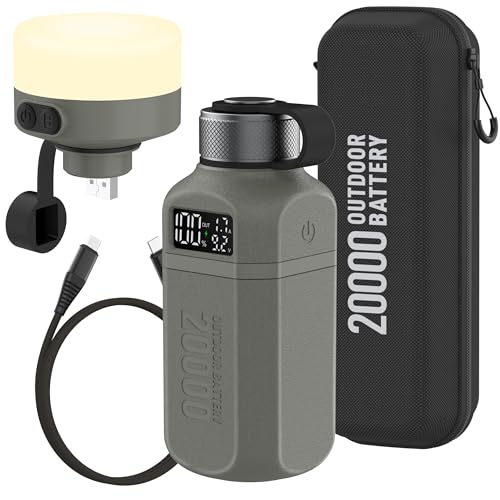
The aswayke P20 is the best rugged fast charging power bank here because it is the only pick with an IP68 claim and a published lantern spec on the same shell.
Best for: campers and hikers who need real weather sealing Skip it if: you want something pocket-sized for city commutes
The P20 is the heaviest pick in the shortlist at 1.48 lb, and it earns the weight. aswayke claims IP68 protection, which the listing describes as surviving 1.5 m of water for 30 minutes and shrugging off dust, sand and mud. Only the BLAVOR PN-W52 also commits to an ingress rating on the tin, and that one stops at IP67. On top of the shell, the 420-lumen lantern with five modes is pre-attached, so you carry one thing instead of two, and there is a tripod mount on the base for hands-free lighting inside a tent.
Capacity sits at 20,000mAh, which aswayke frames as five charges for an iPhone. The digital display shows the percentage plus input and output current in mA, which is more granular than the LED bar most of the others use. The trade-off is real: it is the most expensive pick here, the warranty runs one year against the three-year windows on most rivals, and the P20 is a chunky thing for a jacket pocket.
Pros:
- Only IP68 claim in the shortlist
- Pre-attached 420-lumen lantern with five modes
- Digital display shows percentage and current in mA
- Tripod mount on the base
- One-year warranty stated
Cons:
- Heaviest pick at 1.48 lb
- Highest price position in the set
- One-year warranty is the shortest here
- 20,000mAh is mid-pack for capacity
2. ZZI Portable Charger Power Bank 60000mAh — Runner-up
The ZZI P1 Pro trades a published IP rating for the largest capacity in the shortlist at the second-lightest carry weight.
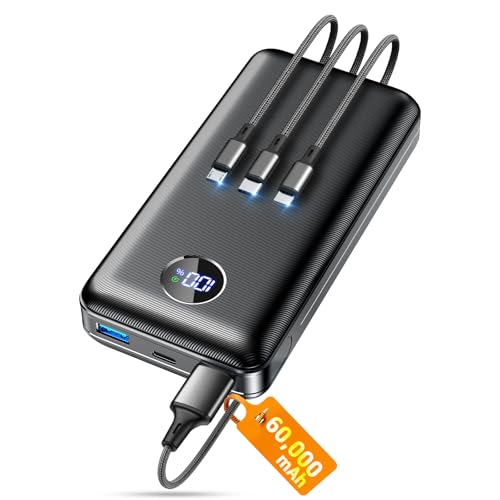
Best for: weekend trips where you charge a phone ten times over Skip it if: you need a published IP rating
The P1 Pro is a curious pick. At 60,000mAh it holds the highest capacity here, and ZZI frames that as ten charges for an iPhone 15. The unit weighs 0.96 lb and measures 1.1 x 5.8 x 2.9 in, which is thinner than the BLAVOR and lighter than the aswayke despite carrying triple the mAh of the winner. It runs at 22.5W and ships with a 3-in-1 braided cable that fans out to USB-C, Lightning-style and Micro USB, plus it can drive five devices at once. The warranty is three years and it sells faster than any other pick in this set.
The catch is straightforward. ZZI does not publish an IP rating, so calling it rugged is a stretch even though the shell looks tough in the listing photos. If you need real weather sealing this is not the right buy. If you do not, this is a lot of power in a slim body for a mid price position, and the sales pace suggests plenty of buyers agree.
Pros:
- Largest capacity in the shortlist at 60,000mAh
- Lightest carry at 0.96 lb given the capacity
- Charges five devices at once, per the listing
- Three-year warranty
- Slim 1.1 in profile
Cons:
- No published IP rating
- 22.5W is slower than the INIU on paper
- Bundled cable set adds bulk on the road
- Not truly rugged despite the shell design
3. SOARAISE Solar Power Bank 48000mAh — Best for pros
The SOARAISE HI-S029 is the only pick with solar panels and wireless charging, aimed at multi-day trips where you want a backup input source.
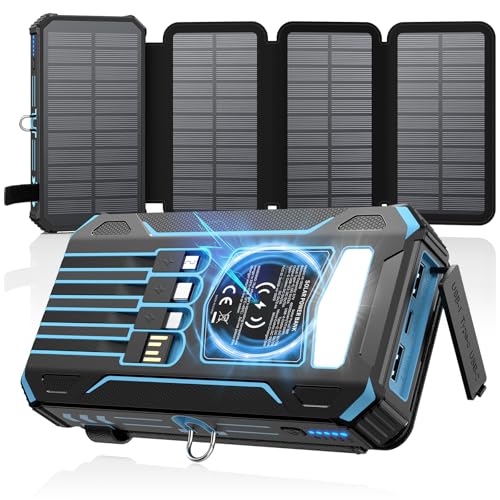
Best for: multi-day trips with sun exposure and mixed devices Skip it if: you want a compact carry
The HI-S029 stacks features no other pick here offers. Four solar panels feed the 48,000mAh battery, SOARAISE claims wireless charging on top, and the unit ships with four built-in cables plus three ports (two USB-A and one USB-C in/out). The stated USB-C output is 5V/3A, which the listing frames as taking an iPhone from 15% to 60% in 30 minutes. Dimensions are 3.43 x 6.38 x 1.57 in.
Two things to know before you buy. First, there is no IP rating on the tin, which matters more here than on the ZZI because the whole pitch is outdoor use. Second, "5 times faster than standard single-panel chargers" is SOARAISE's own comparison; a folded four-panel array still charges slowly in overcast weather, and solar is best treated as a top-up rather than a primary charge path. This is a pro pick because it has the most inputs and outputs in the set, not because it is the fastest.
Pros:
- Only solar input in the shortlist
- Wireless charging pad on the shell
- Four built-in cables plus three ports
- 48,000mAh capacity
- Second-largest battery here
Cons:
- No published IP rating
- 5V/3A is a mid-pack wattage
- Bulkiest footprint of the six
- Solar output depends heavily on conditions
4. BLAVOR Portable Power Bank 15000mAh — Best for beginners
The BLAVOR PN-W52 pairs a LiFePO4 battery with an IP67 claim, so a first-time buyer gets both a long-cycle chemistry and real weather sealing.

Best for: day hikers who want a long-lived battery chemistry Skip it if: you need to top up a laptop
The PN-W52 is the only pick in this shortlist built on LiFePO4 (LFP) cells rather than standard lithium-ion. BLAVOR claims 3,500+ charge cycles for that chemistry, which the listing frames as roughly triple the lifespan of standard lithium-ion. The shell is IP67-rated with a secure-seal lid and silicone gaskets, and there is a USB-C to USB-C cable integrated into the lanyard so you carry the cable and the bank as one object. The tubular 2.1 x 7 x 1.6 in shape sits in one hand.
Trade-offs are honest. Capacity is 15,000mAh, the lowest here after the INIU, so this is a day-hike unit rather than a weekend brick. The USB-C PD output is rated at 20W, which BLAVOR describes as taking an iPhone 16 to 50% in 30 minutes; that is fine for a phone but light for a tablet or a laptop. The three-year manufacturer warranty and the IP67 rating are what earn the beginner label: fewer things to go wrong, and easier to trust in a downpour.
Pros:
- LiFePO4 cells with 3,500+ cycles claimed
- IP67 rating on the shell
- Integrated USB-C lanyard cable
- Three-year warranty
- One-handed tubular grip
Cons:
- 15,000mAh is small for multi-day use
- 20W PD is not enough for laptops
- No digital percentage display
- Only one built-in cable
5. JKELAR 50000mAh Portable Charger — Best minimal setup
The JKELAR P8 is the pick to buy if you keep leaving cables at home, because it builds two of them straight into the shell.

Best for: travellers who forget cables Skip it if: you need any water or dust rating
The P8 is a 50,000mAh brick with two built-in cables, one Lightning-style for iPhone and one USB-C for everything else. The listing states 22.5W fast charging, an emergency flashlight and a smart LED display, plus a three-year replacement warranty. It weighs 1.08 lb and measures 1 x 6.5 x 3.5 in, which is the second-thinnest profile here. That combination of capacity, weight and integrated cables is genuinely useful for travel: throw it in a bag and you never lose a charge because a cable stayed on the desk.
Where it slips is exactly where the search term points. JKELAR does not publish an IP rating for the P8, and there is no mention of shockproofing or gaskets in the specifications. It is a fast charging power bank with a lot of capacity, but the "rugged" half of the phrase is not supported by the listing. Keep this one in a bag, not clipped to a pack in the rain.
Pros:
- Two built-in cables cover most phones
- 50,000mAh capacity for long trips
- Three-year replacement warranty
- 22.5W fast charging claim
- Emergency flashlight included
Cons:
- No published IP rating
- No shockproofing spec on the listing
- Built-in cables can wear out first
- Not truly rugged despite the shell
6. INIU Power Bank 10000mAh 45W PD — Best budget pick
The INIU P55 delivers the highest stated wattage in this shortlist at the lowest price position, in a body that fits an inside jacket pocket.

Best for: everyday carry with the highest stated wattage in this set Skip it if: you need multi-day capacity
The P55 is the smallest and cheapest pick, and its numbers on paper are punchier than the size suggests. 45W PD is the highest stated fast charging figure in this shortlist, ahead of the 22.5W the ZZI and JKELAR quote. INIU frames that as taking an iPhone 17 Pro to 65% quickly and driving tablets and handheld consoles too, not just phones. The unit is 0.7 x 4.4 x 2.7 in, which INIU describes as 27% smaller than a previous generation, and the detachable nylon-braided USB-C lanyard doubles as the charging cable so you rarely dig through a bag.
The compromises are the ones you would expect from a compact pick. Capacity is 10,000mAh, which the listing frames as roughly two iPhone charges or twelve AirPods Pro top-ups; that is a commute unit, not a weekend unit. There is no IP rating on the tin, so this is a fast charging power bank first and a rugged one not at all. If you carry a phone and want the fastest top-up in this set for the least outlay, the P55 is the pick.
Pros:
- Highest stated wattage in the set at 45W
- Smallest footprint here
- USB-C lanyard doubles as the cable
- Three-year warranty
- Cheapest of the six
Cons:
- 10,000mAh is the lowest capacity here
- No published IP rating
- Not intended for laptops
- One port limits simultaneous charging
What buyers get wrong about capacity
Capacity is the number most shoppers compare first, and it is the wrong place to start. A 60,000mAh brick sounds like six times a 10,000mAh unit, and on the label it is. In practice, published mAh figures measure the cell before conversion losses, and every pick here converts down to 5V output through internal circuitry that eats some of the headline number. Two banks with identical mAh ratings can deliver noticeably different real-world charges depending on the output voltage and the device.
Wattage is the figure that decides how quickly a bank refills your phone between stops. The INIU P55 quotes 45W, the ZZI P1 Pro and JKELAR P8 quote 22.5W, the BLAVOR PN-W52 quotes 20W, and the SOARAISE HI-S029 quotes 5V/3A. Higher watts means shorter top-ups, up to whatever your phone will accept.
Two practical thresholds:
- Under 20W, plan on a full sit-down to reach 80%.
- 30W and up, a 15-minute break covers most of a day.
Match wattage to how you actually charge, not to the mAh on the box.
IP ratings, wattage and what actually decides this
The real deciding criterion for a rugged fast charging power bank is the intersection of three things: a published IP rating, a stated wattage you can plan around, and a capacity that matches your trip length. Miss any one and the pack falls back to being a normal power bank in a tougher-looking shell.
- IP rating: only the aswayke P20 (IP68) and the BLAVOR PN-W52 (IP67) publish one. The other four are silent, and silence is not a claim you can rely on.
- Wattage: INIU leads at 45W, ZZI and JKELAR quote 22.5W, BLAVOR quotes 20W, and SOARAISE quotes 5V/3A. aswayke does not headline a wattage figure.
- Capacity: ZZI at 60,000mAh, JKELAR at 50,000mAh, SOARAISE at 48,000mAh, aswayke at 20,000mAh, BLAVOR at 15,000mAh, INIU at 10,000mAh.
Only the aswayke P20 and the BLAVOR PN-W52 satisfy the rugged half of the search term with a published rating. The other four are strong fast charging power banks with outdoor-friendly designs, but the tin does not commit to ingress protection, and that gap matters if you plan to expose the unit to rain, mud or a river crossing. Decide first whether you need the rating; that answer alone splits this shortlist in half.
How to read a fast charging spec sheet
Listings for the best rugged fast charging power bank category are dense with claims, and most of them are either useful or padding. Here is how to sort them fast.
- Look for a wattage figure and the port it applies to. "45W PD" on a USB-C port is planable. "Fast charging" without a number is marketing.
- Look for an IP rating with two digits. IP67 and IP68 both cover dust and water, and the second digit tells you the water depth and duration. IPX-anything skips dust.
- Look for cycle count on the battery chemistry. LiFePO4 banks like the BLAVOR PN-W52 quote 3,500+ cycles, several times a standard lithium-ion pack.
- Look for the warranty period in years. Three years is common in this set; the aswayke P20 breaks that pattern at one year.
- Look for a percentage display, not a four-LED bar. The aswayke P20 shows current in mA on top of percentage.
Feature bullets that flatter the shell without committing to a figure are decoration. Bullets with numbers and units are what you plan a trip around. If a listing describes a bank as a fast charging power bank without publishing a wattage or a port spec, treat it as unquantified.
aswayke vs ZZI: which one should you pack?
These two are the most-compared picks in the shortlist because they solve opposite problems well. The aswayke P20 is the rugged fast charging power bank in this set: IP68 on the tin, a lantern on the shell, 1.48 lb in the hand, and a one-year warranty. The ZZI P1 Pro is the capacity champion: 60,000mAh, 0.96 lb, 1.1 in thick, five devices at once, and a three-year warranty. Both quote fast charging; ZZI publishes 22.5W and aswayke leans on USB-C PD in the title.
Pick the aswayke if the trip involves weather. Rain, river crossings, sand, snow: the IP68 claim is the only one in the shortlist that quotes 1.5 m of submersion, and the lantern replaces a separate torch. Pick the ZZI if the trip is longer than the aswayke's 20,000mAh will cover and the weather is fair. Ten iPhone charges in a 0.96 lb body is a lot of headroom for a base camp or a hotel run, and the three-year warranty gives it the longer replacement window.
The cutoff is water. Above the risk of a soaking, the aswayke wins. Below it, ZZI's numbers do more work per pound.
Who should skip this category entirely?
Not every phone owner needs a rugged fast charging power bank. Three groups should look elsewhere.
- Daily city commuters with reliable power at the office and at home. A slim 5,000 to 10,000mAh pack with no ingress rating is lighter, cheaper and enough. The INIU P55 is the closest fit in this shortlist for that use, though at 10,000mAh it is already borderline.
- Laptop-first travellers who need 65W or 100W USB-C PD to run a laptop between airports. Nothing in this shortlist publishes that ceiling; the INIU tops out at a stated 45W, which is a phone-and-tablet figure.
- Buyers who want wall-outlet AC. Every pick here is a USB-based bank. If you need to run a CPAP machine, a small fridge or a mains-plug device, the category you want is a portable power station, not a power bank.
If none of those describe you, the shortlist above is the right shelf. If any of them do, spending on this category buys features you will not use.
The verdict
The aswayke P20 wins overall because it is the only pick in this shortlist that commits to an IP68 rating and pairs it with a built-in 420-lumen lantern. That combination decides the category more than any single specification, and the digital display showing percentage plus mA current is a small quality-of-life advantage no other pick matches. The one-year warranty is a real drawback against the three-year windows on most rivals, but the rugged claim is what the search term asks for, and only two picks here answer it. The BLAVOR PN-W52 is the other, and its LiFePO4 chemistry gives it the longest-lived cells in the set.
If you are choosing between the winner and the runner-up, the cutoff is weather exposure. The ZZI P1 Pro carries triple the mAh of the aswayke at two-thirds the weight, with a three-year warranty and a stated 22.5W output, but it does not publish an IP rating. Above the risk of rain or a river, that gap disqualifies it. Below it, the ZZI is the better buy on capacity per pound. Match the pick to the trip, not the trip to the pick.
FAQ
What makes a rugged fast charging power bank different from a regular one?
A rugged fast charging power bank publishes an ingress protection rating on the listing and pairs it with a fast charging wattage. In this shortlist, only the aswayke P20 at IP68 and the BLAVOR PN-W52 at IP67 commit to a rating. The other picks may look tough, but without a stated rating the shell claim is not verifiable, and outdoor use puts them at greater risk.
Is a rugged power bank worth it for casual weekend camping?
A rugged power bank is worth it for weekend camping if the forecast includes rain, if you cross water, or if you tend to drop gear on rock. The aswayke P20's IP68 claim covers 1.5 m of submersion for 30 minutes. If your camping is fair-weather car camping with a dry tent, an unrated pack like the ZZI P1 Pro gives you more capacity per pound for the same money.
How many mAh do I actually need for a three-day hike?
For a three-day hike with a phone in airplane mode and occasional GPS, most buyers use around 15,000 to 25,000mAh. The aswayke P20 at 20,000mAh sits in the middle of that window. If you add a headlamp, earbuds, a watch and a camera, jump up to the JKELAR P8 at 50,000mAh or the ZZI P1 Pro at 60,000mAh. Solar picks like the SOARAISE add a slow top-up path in clear weather.
aswayke P20 or BLAVOR PN-W52 for real weatherproofing?
For real weatherproofing, the aswayke P20 leads because IP68 covers a deeper submersion window than the BLAVOR PN-W52's IP67. The aswayke also carries more capacity at 20,000mAh against 15,000mAh, and adds the 420-lumen lantern. The BLAVOR wins on battery chemistry, with LiFePO4 cells claimed at 3,500+ cycles and a three-year warranty against aswayke's one year, so pick it if longevity matters more than depth.
What fast charging wattage is enough for a modern phone?
For a modern phone, a fast charging wattage of 20W to 30W hits the ceiling most handsets will accept over USB-C PD. The BLAVOR PN-W52 at 20W and the ZZI P1 Pro at 22.5W both fit that band. The INIU P55 at 45W has extra headroom for tablets and handheld consoles, but your phone will not draw it all. Match the port spec to your primary device, not to the highest number on the label.
Once you have picked a lane, order the one that fits the trip you are packing for this month rather than the trip you might take next year. The aswayke P20 is the default if weather is on the table, and its lantern earns its pound in a tent. If you already own a torch and your trips run dry, the ZZI P1 Pro gives you a lot more headroom for the same carry. Compact commuters should reach for the INIU P55 and stop overspending on features they will never test. Check the current listing figures against the ones quoted here before you buy, since specifications shift between production runs.